Monday, June 9, 2014

TAIPEI "Cloud of Unknowing"


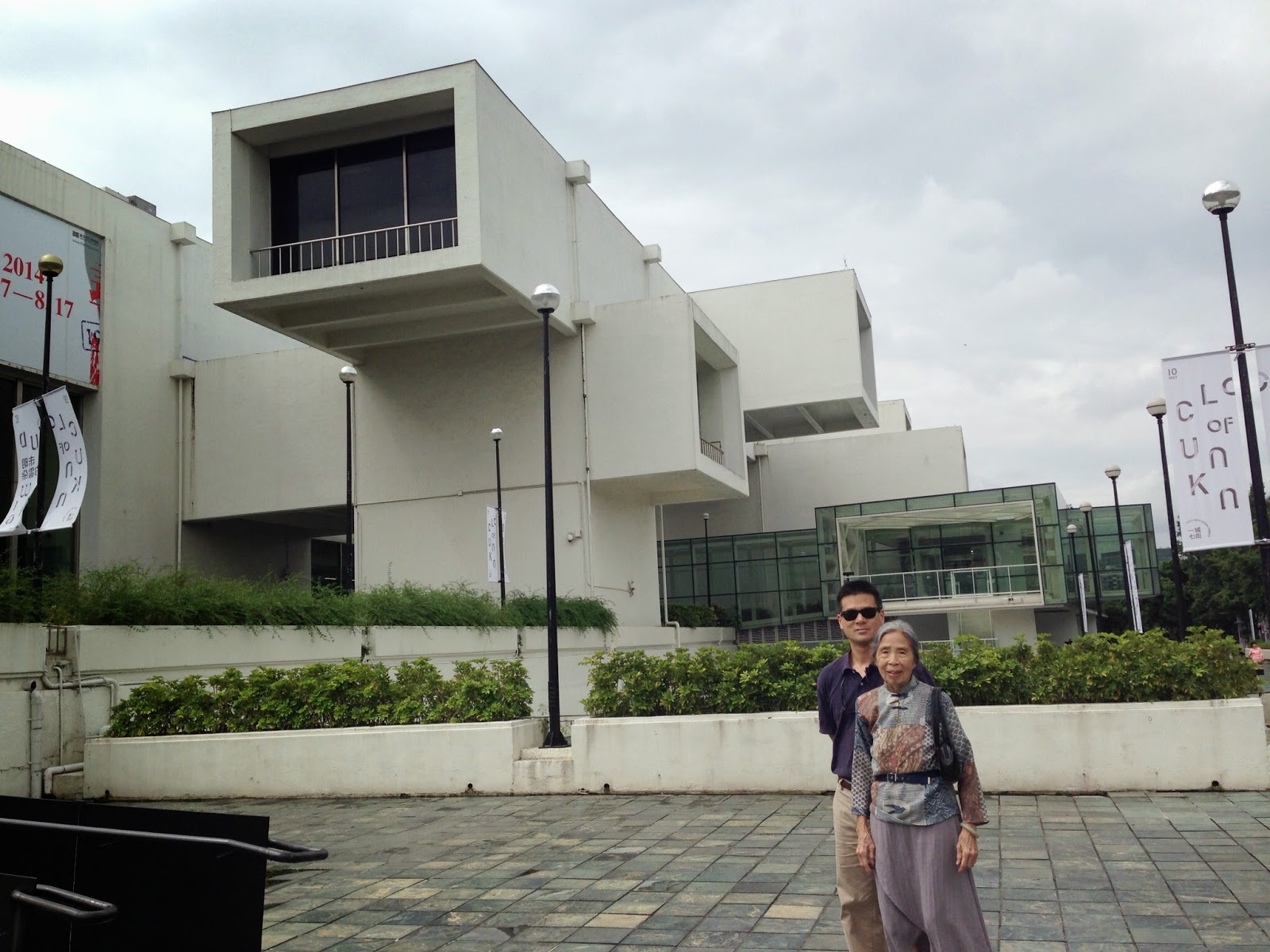
A quick two day visit to Taipei, on my way from Changchun to Tokyo.  My brother also flies in and we spend the weekend with our aunt.  She took us to an exhibit at the Taipei Fine Arts Museum, "Cloud of Unknowing," a consideration of the East Asian city from architectural and environmental angles, with seven installations by Taiwan, mainland, Japanese and South Korean architects and artists.


ink paintings of CY Lee, Taiwan's most prominent architect today (Taipei 101, Beijing Olympics dragon hotel, etc etc) and sort of related to our family.


Painting by Chi-Kwan Chen, a legendary Taiwan architect who studied with Walter Gropius and built one of the first structures with a parabolic roof (a chapel at university in Taiwan).  I loved  this ink study of crabs in a pot.


There was an installation by Japanese artists, architects and photographers. Above, a garage door on a Tokyo side street. Below, manhole covers.  Manhole covers are the  inspired icons of the "rojo kansatugatu" (roadway observation study), a kind of post-modern movement of artists founded in the 1980s who were into street-scapes.  One has to admit, Tokyo does have some interesting manhole covers.

(photo by John Ngai)

making dumplings (xiaolungbao) and fried donuts (youtiao). The "cook" is self-portrait of the artist, who totally gets it. 

This painting of the CCTV tower in Beijing (which my cousin once told me is called "big pants crotch" (da ku cha) by the locals) is part of a kitschy series using Mao-era poster style to mock the 'big brother' dimensions of current Chinese life.

Harbin

On Saturday I took a day trip to Harbin.  Jessie, who was my shopping guide last year, is my guide again.  We took the high speed train and got there in under an hour.  The weekend was unusually hot and humid -- mid-90s.  Harbin is farther north, near the Russian and N. Korean borders. In the late 19 and early 20 century it was a cosmopolitan, industrializing city with Russian and Japanese capital investments in the region, as well as Jewish immigrants from Eastern Europe.  Like other big cities in China there is a lot of new construction but there are random old buildings in European style scattered around, and the city has a charming feel. We visited St. Sofia, early 20-c Eastern Orthodox Church,  which now houses a photo museum of Harbin's history.  Then we went on a wild goose chase looking for the old Jewish synagogue;  followed many people's bad directions and ended up in the old Russian quarter at another Christian church, this one was actually functioning; there were three old Chinese ladies inside who tried to convert us.  We finally found the synagogue, which was built in the 1920s.  After the revolution it no longer was a house of worship.  A cab driver told us it was used by the police a a crime lab, and then was a restaurant.  In 2004 the government restored the building, and installed a museum on Jewish history in Harbin, curated by the local university's Jewish studies center.  There was a map showing origins of Jewish emigrants from Eastern Europe and sure enough, Bialystok was one of the sending cities.

Later we went to a Russian restaurant, on Stalin Blvd across from the riverfront Stalin Park. (In Changchun, Stalin Blvd was renamed People's Blvd, renmin dajie.)  The food was pretty bad, i.e. "beet salad" was diced canned beets with canned peas and some diced potatoes. Only the stuffed cabbage saved it from being a total failure.  We met a group of Asian Americans, recent college grads who are teaching English in China.  They came over to our table because one of them went to Columbia and recognized me.  Then we talked to two guys at another table, one from Australia (Tasmania) and one from Canada, who work for the world's largest producer of potatoes cut up for french fries.  They are grown in Mongolia and their big client is KFC in China.  Jessie won't eat KFC because she said the chickens have an extra toe, on account of the growth hormones they are fed.

St. Sofia, Harbin history museum

Jewish synagogue, history museum


Manchuria redux

After two days in Beijing I fly up to Changchun.  I opted for a better hotel this time (nice view from 20 floor), because it has a swimming pool (indeed, I swam nearly every day at 5:30 am!).  About half the students took my class last year so it was really nice to see them again.  We powered through two monographs (one about Jewish diaspora from Bialystok, Poland, the other about Mexicans and European copper miners in Arizona) and several articles --all in English -- in two weeks, quite a challenge for them.  On the second day the finals of the national championship of the China University Basketball Assoc. took place (I got a tee-shirt that says "CUBA"), and since NENU won last year, the games were held here.  I went with two students who are ardent fans, one a US history student and the other a medievalist (selfie below).  It was crazy, just like the NCAA finals. We beat Guangdong Tech (a good team) in a close game to win the championship again.  #33 is MVP and going to the pro-league (CBA).

in front of NENU library

view of Peoples Square from my hotel room

we won!


part of opening ceremonies--each department of the university shows its flag. can you imagine History, Physics, etc etc parading the court at Dodge gym?


Shopping  here is not easy.  There is a Walmart across from the hotel but it was not very good. There is also a luxury mall next door, with Prada and Gucci etc etc for the Chinese nouveau riches, and it was a week before I discovered the fancy food market in the basement (I got imported cheddar, imported milk and mangosteens) and the food court on the top floor.  I also had two meals at Jiaozi Wang (King of Dumplings) which were awesome.  I have come to like dongbei (northeast) cuisine which is famous for its tofu, rice, and dumplings, and wild vegetables that are grown on Changbai mountain.

Mangosteen -- shan zhu -- my very most favorite fruit

NENU campus, walking to dinner with professor (on left) and students


ASIA June 2014: China

A three-week trip to East Asia, to teach a seminar in US immigration history to MA and PhD students in US history at Northeast Normal University in Changchun.  (Came last year as part of OAH exchange, see last year's blog. They invited me back to teach again.)  First, a stop in Beijing to see my cousin there, and also had lunch with graduate students at Peking University.  Also met my editor at Commercial Press, who promises Chinese edition of THE LUCKY ONES out by end of year.


sautéed silk worms.  Closed my eyes and ate one. Yech! must be an acquired taste.

with Beida students

Egg custard tarts 

Mapo tofu!


Saturday, May 10, 2014

S Elmo

After the last session our bus crawled through traffic back to Naples.  Three of us hatched a quick plan to go to one of the city's hilltops.  We jumped off the bus, made our way to the funicular -- the cable car that runs up the hill through a tunnel--and then walked to Sain Elmo where the sun was just going down.

S Elmo (13 century)

View of city &  Vesuvius from S Elmo 


Funicular station-- last stop at the top. 


Then we went back down and had dinner at this charming restaurant, Trattoria di Fernando.  I had linguine with octopus and cuttlefish, and Neapolitan meatballs.  Pretty good but over salted.  I must say that the food I had here though quite good was not spectacular either. And, weirdly, there was nary a vegetable to be had here.  All pasta, pizza, cheese (ie carbs and fat).  One wonders whether the population suffers from scurvy...  Best food--fresh ricotta and baba au rhum.  And LOL, I spied guests in a Caserta restaurant eating pizza with knife and fork.  


Friday, May 9, 2014

Reggia di Caserta

A small group from the conference went to see the royal palace during the lunch break on Thursday. King Charles VII the first Bourbon king of Naples built it in the mid-18 century, modeling it after Versailles. (And as with many imitators he made it bigger.) Two of us rented bikes and rode from the palace to the waterfall and back. No time to see interior of palace.

P


Web photo but you can see distance to waterfall 


Tuesday, May 6, 2014

Napoli-- Citta in movimiento

Naples, Italy.  I was invited to deliver a keynote to a conference, People on the move--culture, rights and geopolitics--organized by Univ of Naples and sponsored by local Forum on Culture and city of Caserta.  The hotel is right on the seaside promenade;  across the bay is Vesuvius looking gorgeously purple at dusk.   Directly opposite the hotel is a 14-c fortress, an old fishing village which now has restaurants and a marina.


The conference is a weeklong affair and I've already missed several days of "dialogue", cultural performance and poetry. The proceedings are held in Caserta, a town about 40 minutes outside of Naples, where the royal palace (mid-18c) is built.  It is also
 the place where the Camorra, the Naples mafia, was born and apparently still controls much around here.  We are convening at the Belvedere di San Luecio, which the king built as a  hunting lodge and then converted to into the royal silk manufactory.  


Belvedere di S Leucio

This afternoon was a panel of writers speaking on exile-- Ahmed Farah Ali "Idaajaa" (Somali-Italy-Syria-Netherlands-Kenya); Romesh Gunesekera (Sri Lanka-London); Dubravka Ugresic (Croatia-Netherlands); Eva Hoffman (Poland-Canada-NY-London). In the evening there was a reading held in the town theater, with authors reading (in English, Somali, Croatian) with Italian subtitles, with Neapolitan musical interludes.  Idaajaa read from the poems he's been transcribing from oral interviews with Somali people (I believe he's collected 10,000).  Hoffman read from a piece on her deep burial of her native Polish when she learned and sought to master English. It was rather cerebral yet it made me weep